Family budget categories: a practical starting list
Choose useful family budget categories, handle mixed supermarket purchases, and decide when your household needs more or less detail.

The short answer
Start with housing, bills and utilities, groceries, dining out and takeaway, transport, healthcare, children and education, supplies and home, personal care and clothing, debt payments, savings and family goals, and fun, gifts and travel. Start broad, then add detail where it helps you set a clearer limit or understand where the money went.
A family budget does not need dozens of categories. It needs labels that everyone understands and will actually use.
A useful budget works as a monthly cycle: list the household income and expenses, compare the plan with what was spent, then use what you learn for the next month. Categories make that review more useful by breaking one large spending total into parts you can understand.
A practical family budget category list
Start with this list, then combine or add categories to suit your household.
| Category | What normally belongs here | Split it further when… |
|---|---|---|
| Housing | Rent, mortgage, service charges, council or property taxes | You need to see ownership costs separately from the monthly payment |
| Bills and utilities | Electricity, gas, water, internet, phone | One bill varies enough to need its own limit |
| Groceries | Food and drinks bought for home | You want to separate essential food, snacks or special dietary costs |
| Dining out and takeaway | Restaurants, cafés, delivery and takeaway | Work lunches or family outings need different limits |
| Transport | Fuel, public transport, parking, taxis and vehicle costs | Vehicle finance, maintenance or commuting needs separate planning |
| Healthcare | Medicine, appointments, dental care and health insurance | A regular treatment or insurance payment needs its own view |
| Children and education | Childcare, school costs, clothes, activities and pocket money or allowance | School, childcare or activities are substantial enough to manage separately |
| Supplies and home | Cleaning products, furniture, appliances, repairs and garden costs | Everyday supplies are hiding larger home purchases or maintenance |
| Personal care and clothing | Toiletries, haircuts, beauty products, adult clothing and shoes | Each household member has a separate spending limit |
| Debt payments | Credit cards, personal loans and other repayments | You need to track different repayment plans separately |
| Savings and family goals | Emergency savings and money set aside for future holidays, education or planned purchases | Each goal has a different date or contribution target |
| Fun, gifts and travel | Entertainment, hobbies, celebrations, presents and actual travel spending | One area regularly uses money intended for another |
Your categories do not need to match another household’s list. What matters is that the labels are clear enough to show where the money went. A category such as “shopping” is often too broad to do that.
Treat insurance according to what it protects. Health insurance can sit under Healthcare, home insurance under Housing and car insurance under Transport. Money saved for a future holiday belongs under Savings and family goals, while the actual trip spending belongs under Fun, gifts and travel.
Other categories may be important for your household. These can include pets, charity, taxes, work expenses and money used to support relatives. Family support deserves a clear place if it is a regular part of what your household does, even if another family would not need that category.
Categories should describe the purchase, not just the shop
A bank transaction is good at answering one question: where did the payment happen? That is not always the same as what did the household buy?
Most banking apps categorise a payment using information such as the merchant and the total. They do not normally see every item printed on the receipt, so the category describes the transaction rather than everything the household bought.
That difference matters at supermarkets, department stores, petrol stations and online marketplaces. One payment may cover several parts of family life.
Merchant-level view
Supermarket
£128.40
GroceriesOne shop, one total, one estimated category
Item-level view
The same £128.40 shop
- Groceries
- £78.10
- Supplies and home
- £21.60
- Children and education
- £18.50
- Personal care
- £10.20
Four useful totals from one receipt
It is still the same £128.40 shop, but the itemised view makes it easier to see why grocery spending rose.
You do not need to split every receipt down to the last item. Keeping a £2 pack of sponges in the overall shop is fine. If a £50 children’s clothing purchase is being counted as food, split it out.
Should groceries and household supplies be separate?
Keep them together when the household wants one simple limit for everything routinely bought at the supermarket. This can be easier to maintain, especially when non-food products are a small and stable part of the shop.
Separate them when you need to understand food spending on its own, when cleaning and personal products are substantial, or when different people manage those parts of the household. The same applies to baby supplies, pet food and alcohol. Give them separate categories only when doing so changes how you plan or review spending.
The important question is not, “What would another family call this?” It is, “What do we need this total to tell us?”
How many categories should a family use?
There is no correct number. Start with the 12 broad categories above, then adjust after one or two months.
A long list can look organised while making everyday tracking harder. A very short list can hide the reason a category keeps going over its limit. Choose the smallest list that still explains where your money is going.
Use this test whenever you consider adding another category.
Would seeing this separately change a decision?
If not, keep the broader category.
Does it need its own limit or goal, or does someone need to manage it separately?
If yes, a separate category may help.
Is it repeatedly hidden inside groceries or another broad category?
If yes, separate it for the next review.
You can also merge categories. If clothing and personal care remain small, predictable and managed by the same person, one combined category may be enough. Your categories are not set in stone. Change them when your household or spending changes.
Categories families commonly forget
Monthly expenses are easy to remember. The harder ones happen less often, but are still predictable.
Look back over several months so you do not miss costs such as insurance, medical expenses, school clothes, education costs, support for family members, gifts and holidays. Check for:
- School fees, uniforms, supplies, childcare and children’s activities
- Annual insurance, licences and memberships
- Home maintenance, repairs and replacement appliances
- Car servicing, tyres and registration
- Medical, dental and prescription costs
- Birthdays, religious celebrations, weddings and other gifts
- Money sent to or spent on relatives
- Pet food, veterinary care and grooming
- Holidays, family visits and travel
- Subscriptions and other recurring services
A category tells you what the money was for. “Recurring”, “annual” and “irregular” tell you when or how often the expense happens.
For example, annual car insurance may still belong under Transport. A yearly school payment may still belong under Children and education. Record each expense by what it is for, then plan for when it is due.
Agree on the categories as a household
Everyone using a shared budget should use each category in the same way.
Decide together whether toiletries count as Personal care and clothing or Supplies and home. Agree whether family meals out belong under Dining out and takeaway or Fun, gifts and travel. If one person calls every online purchase Shopping while another assigns each item by purpose, the totals will not answer the same questions.
You do not need a long family meeting. Start with three decisions:
- Which broad categories will everyone use?
- Which mixed purchases are worth separating?
- Who reviews unclear or miscellaneous expenses?
Once you have agreed on the names, use them consistently for a month. You can then review the unclear purchases together and adjust the categories that are causing confusion.
How FamSpendy handles a mixed purchase
FamSpendy starts with the receipt. It finds the merchant, total and individual items for you to review. Each item can have its own category, so food, cleaning products and children’s clothes from the same shop do not have to share one label.
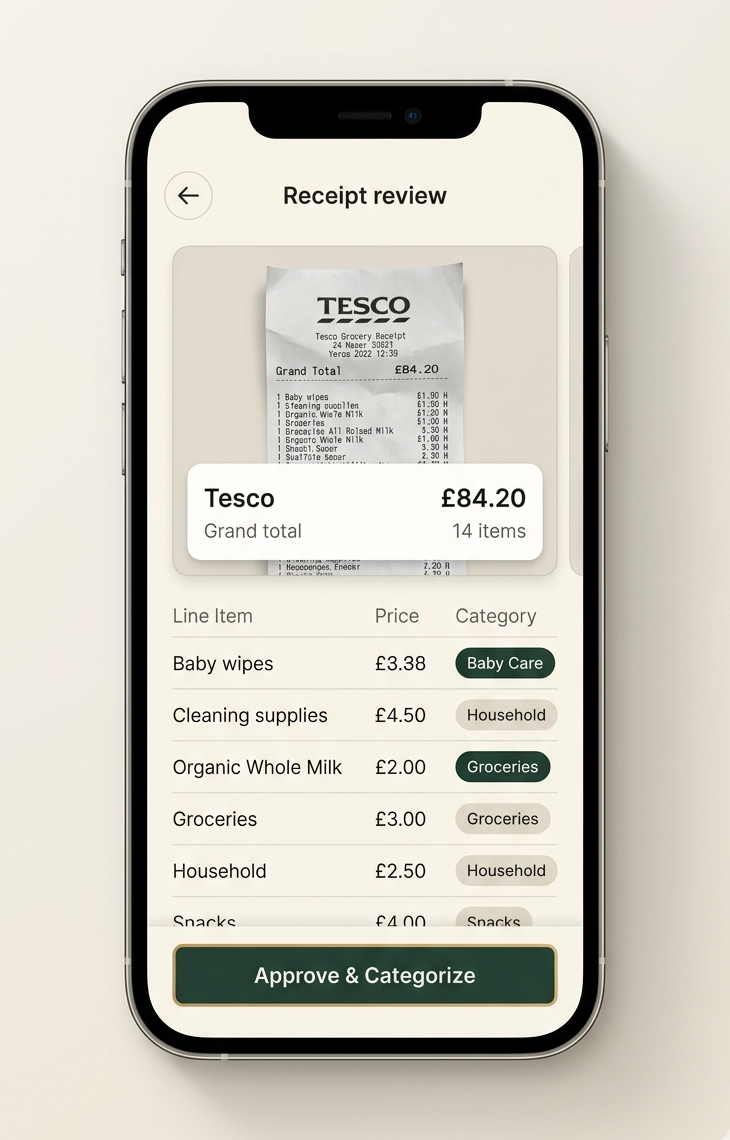
You can also create categories that fit your household, so future reviews show the spending details you care about.
What to do next
Choose the broad categories that fit your household, then review one recent month of spending. Pay particular attention to supermarkets, online marketplaces and other shops that sell several kinds of products.
Split a category when it is hiding spending you want to understand. Merge categories you rarely use separately. Then use the same structure for the next month and review it together.
In FamSpendy, scan one mixed receipt and check the item categories. That gives you a cleaner starting point for your next spending review.
Common questions
What categories should be included in a family budget?
Start with the 12 broad categories in this guide. Add another category when it needs its own limit or you regularly want to review it separately.
How many budget categories should a household have?
There is no magic number. Keep the categories your household will use, combine ones that are too small to matter, and split any that hide spending you need to control.
Should groceries and household supplies be separate categories?
Separate them if you want to understand food spending or set different limits for food and household products. Keep them together if the distinction would not affect your choices and a simpler budget is easier to maintain.
Should savings and debt payments be budget categories?
Yes. Include planned savings and debt repayments so they are part of the monthly plan. You can organise them as categories or goals, depending on how your household manages its budget.
How should I categorise a supermarket purchase with different items?
Use the receipt to split larger or important items between categories such as Groceries, Supplies and home, Children and education, and Personal care and clothing. Leave minor items in the broader category when separating them would not tell you anything useful.
What should I do with annual and irregular expenses?
Look back across several months for costs such as insurance, school expenses, repairs, gifts and holidays. Put each one in the category that describes its purpose, then set money aside before the payment is due.
Put the guide into practice
Build a budget your household can understand together
Create categories that fit your family, scan mixed receipts and keep everyone's spending in one shared place with FamSpendy.
7-day free trial. Cancel anytime.
Keep reading

Groceries, toiletries and household supplies: together or separate?
Decide whether food, toiletries and cleaning products need separate budget categories, with a simple test and a realistic mixed-shop example.

How many budget categories should a household use?
Choose enough budget categories to explain your household spending without creating a system that takes too much effort to maintain.

When only one person manages the family budget
Reduce the household money admin carried by one person, even when other family members do not want to manage the entire budget.